
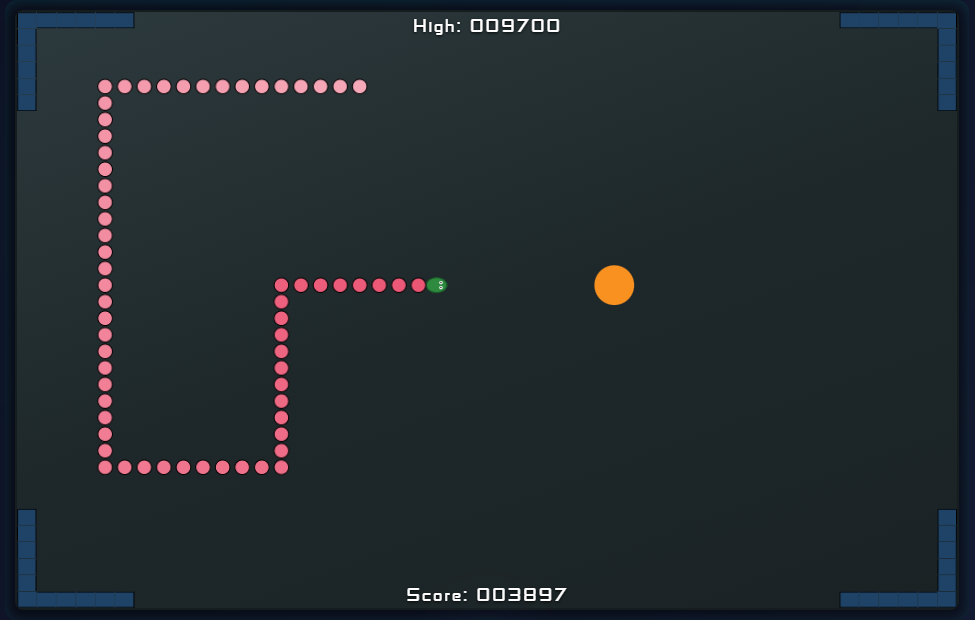
Snake is one of those games everyone thinks they already understand: move, eat, grow, do not crash. That part is true, but it hides the real depth. Good Snake is less about panic reactions and more about path design. You are constantly choosing between short-term points and long-term survival geometry.
What actually decides your score
Most losses do not happen because your fingers are too slow. They happen 6-10 moves earlier when you take a line that quietly removes future options. In Snake, every food pickup rewrites the map. Your body becomes both your engine and your obstacle, so the quality of your route matters more than one fast turn.
That is exactly why Snake works for short breaks: each run gives immediate feedback on decision quality. You can test one habit, see the result, and improve in minutes.
The three habits that separate stable runs from random ones
- Plan two turns ahead minimum. Before taking food, check your exit lane. “Can I leave this area cleanly?” is a better question than “Can I reach food now?”
- Preserve board space, especially center mobility. Hugging walls too long feels safe, but it reduces escape angles when your snake gets longer.
- Prefer repeatable paths over heroic saves. A boring, controllable route scores higher over time than chaotic near-collisions.
A practical 2-5 minute Snake loop
When time is short, use this loop to turn quick play into consistent improvement:
- Start with control, not greed. First 10-15 moves should build open space and rhythm.
- Take low-risk food lines. If a food pickup forces a tight corner, delay it and reset position first.
- Re-stabilize after each growth. Every increase in length changes your turning radius and safe lanes.
- Set a clear stop point. End after one strong run or one tested improvement focus.
Common mistakes that quietly end good runs
- Food tunnel vision. Chasing the nearest item without exit planning creates self-traps.
- Late-turn drifting. Waiting too long to commit to a turn is a classic wall crash pattern.
- Overusing edge cycles. Edges are useful, but living there full-time removes flexibility.
- No recovery pattern. Without a default “reset route,” bad positions snowball quickly.
- Speeding up mentally after a streak. Confidence is good; rushed inputs are not.
Why Snake is still one of the best focus resets
Snake gives you clean constraints and immediate consequences. There is no inventory, no quest log, no setup overhead. You enter, concentrate, and leave with a measurable result. That makes it ideal between tasks: short enough to fit a break, structured enough to reset scattered attention.
On Do Not Disturb Me, you can open Snake instantly and run one focused session without friction. No install, no account wall, just one clear challenge.
Try one objective on your next run
Pick one rule before you start: “I never take food without an exit,” or “I keep center access open at all times.” Small, measurable goals beat vague “play better” intentions. Over a few short runs, your scores will improve because your decisions improve first.
Open a round of Snake and play for control. High scores follow.