
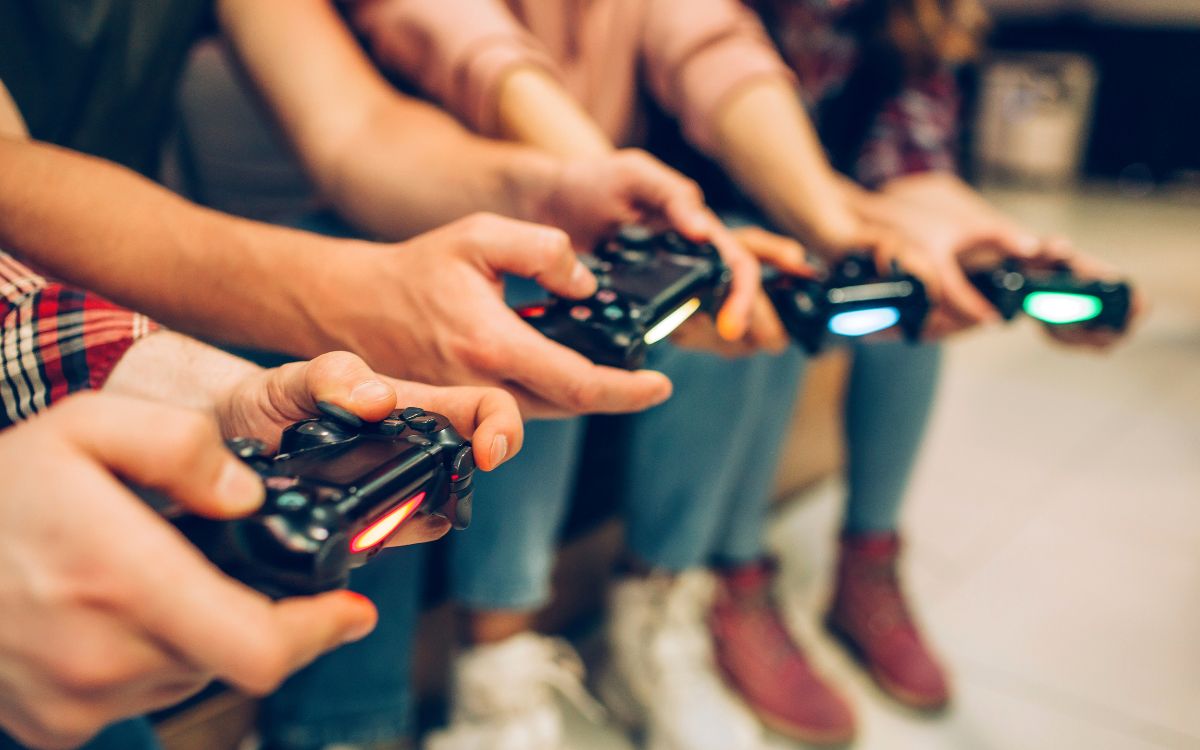
For many people today, video games sit alongside messaging friends, studying, commuting, and unwinding after work—not as a rare subculture, but as a normal part of the week. This article explains, in plain language, what roles games often play in modern life, where the medium came from, how the industry is organized, and what research literature currently suggests about benefits and costs. It is informational, not medical advice.
Why games sit so close to daily life
Most people do not install a game because they want “a product.” They want a function in a busy week: a way to laugh with someone far away, a twenty-minute reset between tasks, a fair challenge with clear rules, or a story that helps them switch off from worry. Those motives are ordinary—and they help explain why interactive games show up across ages, incomes, and cultures.
Unlike endless passive feeds, many games ask for decisions, timing, and clear feedback. That active loop can feel restorative when it matches your needs, or draining when it does not. The difference is usually context: duration, sleep, social tone, and what the game displaces from your day.
Four roles we actually use games for
The title names four roles that researchers and player surveys return to again and again. They overlap in real life, but separating them helps you think clearly about your own habits.
1. Connection
Cooperative missions, party games, voice chat during a build, or simply sharing a screen on a sofa all turn play into shared time. For children and teenagers, games are often one of the main places where friendships are rehearsed: teamwork, fairness, joking, and sometimes conflict resolution. For adults, they can keep ties alive across time zones when a phone call feels too formal.

2. Learning (not only “school learning”)
Games teach systems: rules, incentives, patterns, and consequences. Educational designers sometimes use “serious games” or game-like lessons because motivation and immediate feedback can support practice. Outside classrooms, players still learn—muscle memory in a platformer, probability intuition in card-style games, project planning in sandbox worlds. The learning is real; it is also specific to the game, so transfer to unrelated skills is never automatic.
3. Rest and recovery
Short sessions can act like a mental palate cleanser between deep-work blocks—something this site is designed around. Rest becomes a problem mainly when play replaces sleep, movement, or in-person obligations you value. Thinking of games as timed recovery rather than an open-ended default often preserves the benefit.
4. Identity and expression
Avatars, usernames, creative modes, mods, and streaming personas let people explore tastes and social presentation in a bounded space. For some players—especially younger people—this is a meaningful part of how they try on confidence, style, and community membership. It can be supportive; it can also create pressure to perform or compare. Like any social space, the health of the experience depends heavily on norms, moderation, and who you play with.
Childhood: why games feel “important” early
Childhood is a phase of rapid social learning and habit formation. Games meet children where they are: curious, reward-sensitive, and still learning self-regulation. That combination explains both the upside and the responsibility adults carry.
- Peer belonging: shared play can strengthen friendships when it stays kind and inclusive.
- Competence: clear goals and visible improvement support a sense of mastery.
- Routine: predictable sessions can comfort; unpredictable “one more match” loops need gentle boundaries.
Major health organizations emphasize context: age-appropriate content, screen-time balance with sleep and physical play, and open conversation—not fear-based bans alone. If you have concerns about a child’s mood, sleep, or schoolwork, a qualified professional is the right source for individualized guidance.
Roots of games: two timelines that meet in today’s hobby
When people say “origins of games,” they usually mix two histories. Both are true, and both shape modern design.
A. Deep history: boards, pieces, and public life
Humans have played rule-based games for thousands of years. Archaeology and museum scholarship document early board games as part of culture and ritual, not only idle amusement. Examples often cited in reputable museum and encyclopedia sources include Senet in ancient Egypt (discussed by institutions such as The Metropolitan Museum of Art) and Go in East Asia, with a documented tradition spanning millennia. The shared lesson is straightforward: structured play has long been a way to practice patience, strategy, and cultural belonging.

B. Electronic games: laboratories, arcades, and living rooms
The video game medium grew out of post-war computing and display experiments. Milestones commonly recorded in university histories and computing archives include:
- Early 1950s: simple computer demonstrations such as tic-tac-toe on early machines (often cited in histories of computing).
- 1958: Tennis for Two, created at Brookhaven National Laboratory as a visitor demonstration—frequently described as an early interactive electronic game.
- Early 1960s: Spacewar! developed at MIT, spreading across academic computing networks.
- 1972: Pong helped establish coin-op and then home TV-based play as a commercial category.
From there, the story is one of falling hardware costs, better graphics, and networks—first local multiplayer, then online services—until games became a default entertainment form alongside music and film.
Studios, publishers, and platforms: who contributes what
Modern games reach players through a chain of specialized roles. Understanding the chain explains pricing, updates, cross-play, and why some titles exist only on certain devices.

Development studios
Studios employ designers, programmers, artists, audio specialists, and testers. They turn a concept into a build. Some studios are tiny independents; others employ thousands. Working conditions and “crunch” vary sharply by company and project; those stories deserve dedicated reporting rather than a single sweeping claim in an overview article.
Publishers
Publishers often fund marketing, localization, quality assurance at scale, and physical distribution where it still exists. In exchange they take revenue share and help coordinate launch timing. Independent “self-published” games still use storefronts and payment systems; the label only means the creative team kept more of the business control.
Platforms and storefronts
Consoles (vendor-specific hardware and operating systems), PC (open hardware with competing launchers), and mobile (app stores with in-app purchase norms) each shape what games look like: session length, business model, and discoverability. Cloud streaming is a smaller but growing layer that shifts some computing to data centers; it changes access more than it replaces game design itself.
Industry analysts publish global market snapshots because the totals help investors and policymakers. Figures differ by methodology (consumer spend vs. hardware bundles vs. advertising). For example, Newzoo’s public updates discuss global interactive entertainment revenue on the order of roughly a few hundred billion U.S. dollars annually in recent years, with mobile, PC, and console each contributing meaningful slices. Treat any single number as an estimate with definitions attached, not a physical measurement.

What scientific investigation tends to find
Science moves slowly and by replication. The fairest summary is: games are neither a miracle tool nor a universal harm; effects depend on game type, session length, life context, and individual vulnerability.
Cognition, attention, and perception
Peer-reviewed meta-analyses and reviews have asked whether action-oriented video game play correlates with benefits in attention and certain perceptual skills. Many report small to moderate associations in specific lab tasks. The same literature repeats important caveats: cross-sectional designs can confuse cause and effect; publication bias can inflate headlines; and transfer from a game to unrelated real-world grades or jobs is not something you should assume without evidence for your specific situation.
Mental health and “gaming disorder”
The World Health Organization’s ICD-11 classification includes gaming disorder as a clinically defined pattern of persistent impaired control, priority escalation, and continuation despite harm. Researchers debate prevalence thresholds and screening tools; longitudinal studies often report bidirectional links between problematic gaming patterns and mood or distress—meaning correlation is clearer than simple one-way causation.
Practical takeaway for readers: if gaming feels impossible to stop despite serious consequences, or if mood and sleep collapse, that is a signal to seek professional support—not a reason for shame, and not something a blog article can diagnose.
Pros and cons in one honest view
| Potential benefits (when play fits your life) | Tradeoffs and risks to watch |
|---|---|
| Social connection, teamwork, and shared laughter | Toxic chat, harassment, or pressure to keep up socially |
| Skill practice: reaction time, spatial reasoning, planning | Displacement: less sleep, movement, or offline responsibilities |
| Stress relief and structured “off time” | Monetization loops that encourage overspending or compulsion in susceptible players |
| Creativity in sandbox titles and communities | Escapism that avoids rather than addresses ongoing problems—fine as rest, risky as a sole strategy |
Bringing it back to your week
Games are tools for time and attention—similar to books or team sports in that they can absorb minutes wisely or unwisely. They can support connection, learning, rest, and identity when the format matches the time you actually have. If you want light structure between tasks, the browser game hub here is built for short sessions; the how to play section covers site-wide tips.
Editorial note: this article summarizes widely accepted history and cautious research readings. It does not replace medical, psychological, or legal advice.
Sources for further reading (editorial independence)
- WHO ICD-11 — 6C51 Gaming disorder (official classification context)
- Brookhaven National Laboratory — history note on early electronic tennis display
- The Metropolitan Museum of Art — ancient Egyptian board games
- Newzoo — global games market reports (industry sizing methodology)
- Open textbook chapter — evolution of electronic games (teaching-oriented timeline)